Durham summers and mold
Most of the country gets its rain in winter or spring. Durham gets its wettest months from July through September, when the air is already warm and full of water. That combination, more than any single storm, is why mold is a Durham problem.
On this page
What the rain record shows
Raleigh-Durham International Airport averages 46.1 inches a year (1991-2020), and 56 percent of it falls from April through September. July averages 5.02 inches, August 4.71 and September 5.15. The rain comes hard: the airport now averages 13.4 days a year with an inch or more, up from 11.7 over 1991-2020, and 2018 was the wettest year in the record at 60.33 inches.
Average rain by month (inches)
Why crawl spaces grow mold
A vented crawl space is open to the outside air. In summer that air is warm and humid, and under the house it meets floor framing and ductwork cooled by the air conditioning above. When a surface is colder than the air's dew point, water condenses on it. Add a storm that leaves standing water under the house, or a downspout that dumps next to the foundation, and the floor joists and insulation stay damp for weeks. That is where the mold starts, and the musty smell in the house above is often the first sign.
Fixes run from cheap to expensive. Downspout extensions and grading move water away from the house. A sealed vapor barrier covers the crawl space floor, and sweating ducts get sealed and insulated. Some houses end up with a closed crawl space and its own dehumidifier. Fixr puts crawl space mold remediation at $500 to $2,000, before any of those fixes.
Where to look first
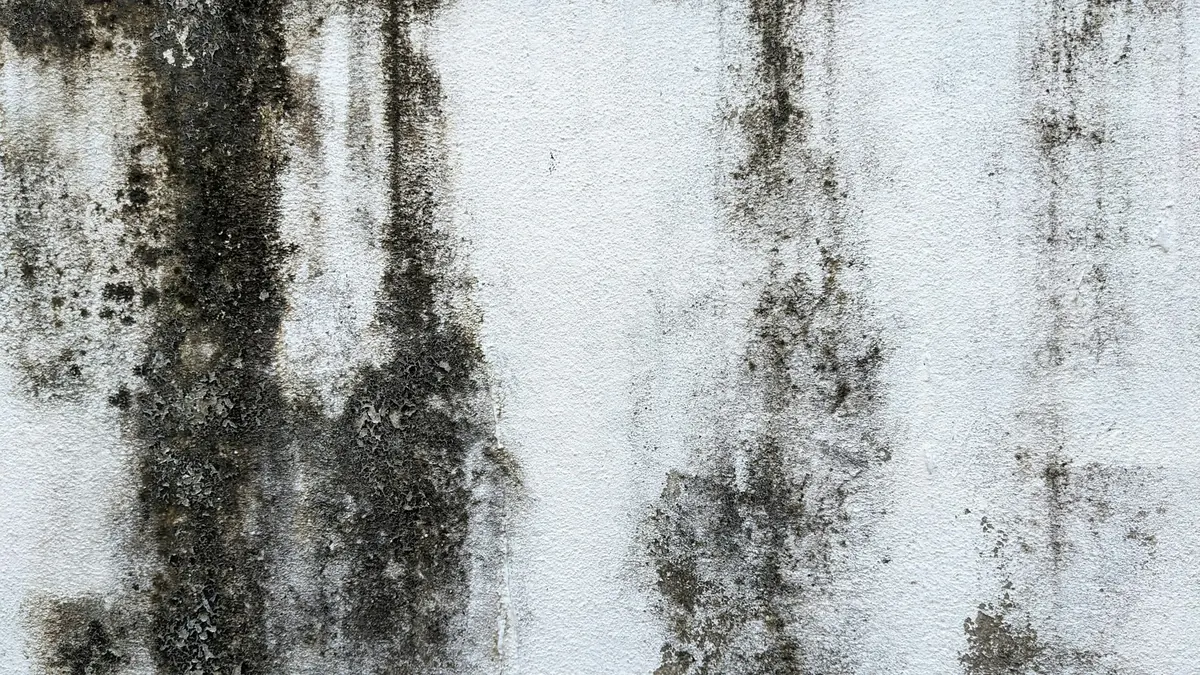
- The crawl space: floor joists, the subfloor, insulation hanging loose or wet, ducts that drip.
- Behind furniture against exterior walls, and at the base of walls in rooms over the crawl space.
- Bathrooms without a working fan, and the ceiling above a shower.
- Around the air handler and the condensate line, which can clog and overflow in summer.
- The attic, if a bath fan vents into it instead of outdoors.
Clean it or call someone?
Small patches, yes. The EPA puts the do-it-yourself limit at roughly 10 square feet, about a 3 by 3 foot area. Anything bigger, mold in the ductwork, or mold that followed sewage or flood water should go to a professional. Either way, fix the moisture first. The EPA's guidance is that cleaning mold without fixing the water problem means it comes back. Mold removal after water damage.
Questions Durham homeowners ask
How fast does mold grow after water damage?
EPA guidance is to dry water-damaged materials and belongings within 24 to 48 hours to head off mold. During a Durham summer the outside air stays hot and humid for weeks, so a soaked wall cavity or crawl space won't dry by itself; it needs a closed house and dehumidifiers running.
Do I need a mold test?
Usually not. The EPA's position is that when you can see or smell mold, sampling is generally unnecessary; what you need is to fix the moisture and clean it. A test earns its cost when you suspect mold you can't find, when someone's health is involved, or when you need proof the cleanup worked.
How much does mold removal cost?
On Fixr's numbers, most remediation jobs cost $1,500 to $9,000 (average $3,500), or $10 to $30 per square foot; Bob Vila's lower range is $1,125 to $3,439. A crawl space job runs $500 to $2,000, and mold in the ductwork $3,000 to $10,000. The swing comes mostly from how much material gets torn out, which is why the scope belongs on paper.
Sources
- NOAA Applied Climate Information System: Raleigh-Durham International Airport daily data (GHCN USW00013722)
- US EPA: A Brief Guide to Mold, Moisture and Your Home (updated February 18, 2026)
- US EPA: Mold Cleanup in Your Home (updated June 4, 2026)
- CDC: Mold (September 26, 2024)
- Fixr: Mold Remediation Cost (updated August 29, 2025)